A reusable AI-native Document Intelligence pattern for complex engineering and manufacturing workflows.
In complex engineering and manufacturing bids, critical information is rarely contained in a single clean document.
Teams may need to work across technical drawings, engineering plans, component schedules, specifications and related technical documents – locating symbols, interpreting context, identifying required materials, validating quantities and reconciling information spread across multiple plans and documents.
That process, commonly referred to as engineering takeoff, converts technical project information into the quantities and material details required to build a Bill of Materials (BOM) and prepare a commercial bid.
For a large enterprise managing complex engineering and bid workflows, this was a highly expertise-intensive and time consuming process. The challenge was not simply to extract information from documents. It was to understand complex engineering content accurately enough to accelerate the entire journey from drawing to bid.
The solution demonstrates how deterministic document processing, AI-based contextual understanding, independent verification and human judgment can be designed together into an AI-native workflow.
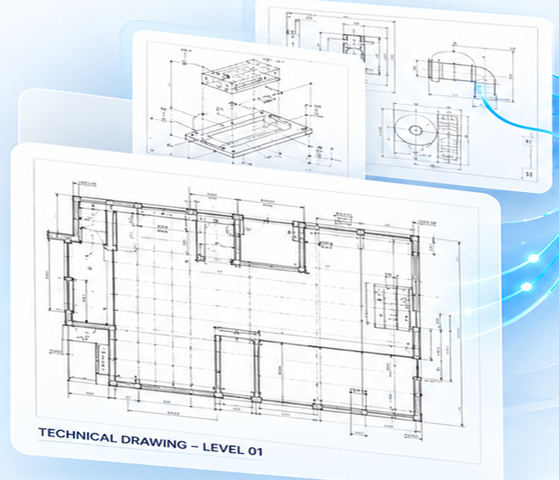
Complex technical drawings can contain large numbers of symbols, locations, annotations and spatial references that must be interpreted and counted accurately during engineering takeoff.
The Business Problem: From Drawing to Bid
Preparing a commercial bid from complex engineering documents requires much more than reading text.
Exact information must be located, interpreted, counted and validated across multiple plan sheets, component symbols, annotations, schedules, specifications and cross-references. Repeated or overlapping plans can create additional risk if the same materials or components are counted more than once.
Three constraints make the process particularly difficult:
- High visual complexity. Engineering plans combine symbols, annotations, tables, schedules, plan overlays and references that need to be interpreted in context.
- Expertise-intensive interpretation. Experienced teams must identify the right information, understand engineering-specific symbols and repeatedly validate component and material counts.
- Difficulty scaling. As bid volumes, document variations and engineering edge cases increase, so does the human effort required to process and verify each opportunity.
The objective therefore was not merely faster document extraction. It was to create a more scalable Drawing-to-Bid workflow – reducing the repetitive effort between receiving complex project documents and producing reliable component and material information for pricing, without requiring engineering effort to grow at the same rate as bid volume.
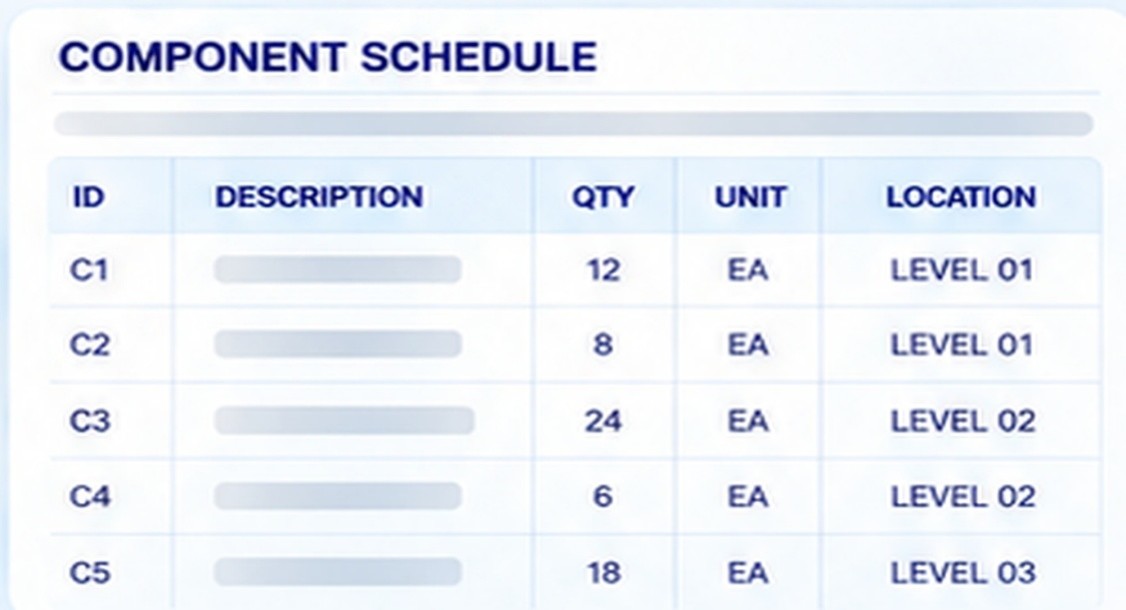
Component schedules add another information layer, with technical attributes such as component type, quantity, unit, location and specifications that must be reconciled with engineering plans and drawings.
Why Conventional Automation Was Not Enough
Complex technical and engineering documents combine several types of information at once: PDF structure, tables, component symbols, annotations, overlapping plans, cross-page references and engineering-specific context.
Some tasks are predictable and can be performed reliably through deterministic code and document-native processing. Others require contextual interpretation.
For example, the workflow may need to determine what type of plan a page represents, interpret symbols in their engineering context, identify relevant project metadata and independently verify information produced by the deterministic processing layer.
A purely rule-driven approach becomes difficult to sustain across document variations and engineering edge cases.
But applying an LLM or Vision-Language Model to every processing step would introduce unnecessary complexity and consumption.
The stronger model is therefore selective intelligence:
- Deterministic processing where document structure and rules are sufficient.
- AI where contextual understanding or verification materially improves the result.
- Human expertise where genuine exceptions require judgment.
That division of responsibility is fundamental to the solution’s AI-native design.
The AI-Native Response
The resulting Drawing-to-Bid workflow combines multiple technologies, with each layer performing the part of the problem it is best suited to solve.
- Document and Table Processing: A Python-based document-processing layer, using PyMuPDF, reads and processes engineering PDFs, supports table detection and performs component and material counting. Azure Document Intelligence extracts structured information from schedules, tables and related document elements.
- Plan Identification and Classification: Claude-based AI/VLM provides contextual intelligence that cannot reliably be derived from PDF structure alone. It supports plan identification and classification, page-level context, project metadata extraction and engineering-specific interpretation.
- Component Understanding, Counting and Verification: The deterministic document-processing layer performs component counting against identified symbols. Claude-based AI/VLM adds symbol understanding and independently verifies extracted counts and identified information.
- Reconciliation and Structured Output: Repeated sheets and overlapping plans are reconciled before validated results are converted into a structured Bill of Materials. Human review remains available for genuine exceptions that require engineering judgment.
Why This Technology Model?
The architecture deliberately avoids making the entire workflow LLM-dependent.
- Python-based processing provides fast, predictable execution for document-native operations and counting.
- Azure Document Intelligence handles structured extraction from schedules and related document elements.
- Claude-based AI/VLM is used selectively where contextual understanding, engineering interpretation, symbol understanding and independent verification add value.
The result is not an AI-native workflow simply because an AI model appears somewhere in the architecture.
deterministic processing, document intelligence, contextual AI, verification, reconciliation and human judgment have been designed together as one end-to-end operating flow.
This also creates a more deliberate processing model: routine document operations remain code-driven, while AI is invoked where additional intelligence materially improves the outcome.
Forward-Deployed Engineering: Connecting the Business Problem to the Solution
Forward-deployed engineering has also played an important role in the engagement.
A NexTurn FDE has worked closely with the client’s product leadership and NexTurn’s AI engineering team across business-case definition, solutioning, AI engineering collaboration and client
The FDE engagement also supports integration with the client’s broader enterprise workflow environment, helping connect the AI capability with downstream commercial processes rather than treating it as an isolated technology implementation.
This proximity to both the business problem and the engineering team helps translate operational requirements into solution design, address integration considerations early and move rapidly from business need to a working enterprise solution.
The FDE continued to work alongside the broader team through the solution’s production deployment, connecting business context, engineering decisions, integration and deployment as one continuous journey.
For NexTurn, this is the essence of forward-deployed engineering: placing engineering capability close to the business problem so that technology is shaped around the real operating context in which it must ultimately perform.
From Solutioning to Production Deployment
The engagement has now reached an important milestone.
The AI-powered Drawing-to-Bid application has been successfully deployed to production. Following deployment, the focus has moved into production monitoring and operationalization – validating how the solution performs in the live environment and establishing the operating model required for sustained enterprise use.
This distinction is important.
Production deployment demonstrates that the workflow has progressed beyond solution development and controlled validation. Operationalization is the next stage: observing the application in real-world use, strengthening the operating process around it and continuing to mature the solution as it encounters production workloads.
How the Drawing-to-Bid Workflow Operates

The workflow is designed to run largely unattended from beginning to end.
- Intake: Complex technical and engineering documents enter secure cloud storage.
- Read & Extract: The document-processing layer reads the PDFs and extracts relevant information. Azure Document Intelligence captures structured information from schedules, tables and related document elements.
- Understand & Count: Deterministic processing identifies and counts component information, while Claude-based AI/VLM adds intelligence around plan context, project metadata and engineering-specific interpretation.
- Verify: The AI/VLM independently cross-checks relevant information produced by the code-driven processing layer.
- Reconcile: Repeated or overlapping plans are reconciled so that component and material information is not counted more than once.
- Deliver: Validated results are converted into a structured Excel Bill of Materials containing component and material totals at the required project breakdown, together with the project-wide total required for downstream pricing.
The important shift is in the role of human expertise.
Instead of engineers manually locating and validating every data point across complex technical documents, human attention can be concentrated on the exceptions that genuinely require judgment.
Trust Engineered into the Workflow
Speed alone is not enough when the output directly influences a commercial bid. An incorrect component or material count can affect pricing and downstream decisions. The workflow therefore incorporates explicit controls around traceability, reconciliation and uncertainty.
- Traceability: Component and material counts remain linked to the source page and position from which they were derived.
- No double counting: Repeated sheets and overlapping plans are reconciled rather than counted multiple times.
- Explicit failure: When the system cannot stand behind a result, the job is surfaced as failed rather than silently returning unsupported information.
The operating principle is straightforward: Automate what can be trusted. Surface uncertainty when it cannot.
Business Impact: From Days to Minutes
The redesigned workflow changes the economics and scalability of engineering takeoff.
- Minutes, not days: A structured, ready-to-price Bill of Materials can be produced in minutes instead of days.
- More projects per bid manager: Reducing repetitive document reading, interpretation and counting enables a bid manager to support meaningfully more projects without requiring an equivalent increase in manual effort.
- Processing economics can follow complexity: Much of the workflow remains deterministic and code-driven, while Claude-based AI/VLM is invoked selectively for contextual understanding, symbol understanding and verification. The entire process therefore does not need to become LLM-dependent.
- Validated accuracy: Across a validated project test set of approximately 40 PDFs, the end-to-end document extraction and BOM-generation flow achieved greater than 95% accuracy, including multiple engineering edge cases that were identified, implemented and validated.
- Production deployment: The solution has now moved into the production environment. Following deployment, the team entered a production monitoring and operationalization phase.
The result is a more scalable Drawing-to-Bid operating model: more bids can move through the workflow, repetitive engineering effort is reduced, AI is applied selectively where intelligence actually matters, and structured output remains traceable and ready for downstream pricing.
Beyond the Demonstrated Use Case: A Reusable Pattern for Engineering and Manufacturing
The demonstrated use case is specific: complex technical and engineering documents are transformed into validated information that accelerates the path from project drawings to a commercial bid.
But the underlying pattern is broader.
Many manufacturing and industrial workflows require teams to work across technical drawings, specifications, component schedules, engineering plans and other cross-referenced documents before usable material, manufacturing or execution information can be produced. The same AI-native architecture can therefore be adapted to adjacent scenarios requiring a combination of:
- Deterministic document processing
- Visual and engineering-context interpretation
- Structured extraction
- Reconciliation across technical documents
- Validation and traceability; and
- Human judgment for genuine exceptions
Illustrative applications could include manufacturing and assembly documentation, engineering specification packs, equipment and component schedules, plant or facility drawings, and other technical workflows where complex source documents need to become reliable, structured information. These are illustrative applications of the underlying design pattern, not delivered implementations from this engagement.
This is where AI-Native Document Intelligence becomes broader than the demonstrated Drawing-to-Bid use case itself.
The opportunity is not to force AI across an entire process, but to redesign work around the respective strengths of deterministic engineering, machine intelligence and human expertise – a principle already embedded in the solution architecture.
AI-native engineering combined with forward-deployed engineering can transform a complex, expertise-intensive business process – from initial business-case definition through solutioning, validation and production deployment.
Write to us at marketing@nexturn.com.
Explore more at https://www.nexturn.com.